

Cognitive Assessment
Cognitive impairment affects learning, memory, attention, and daily function across neurological, psychiatric, and age-related conditions, creating a major challenge for developing therapies that show meaningful benefit. For clients, the key problem is demonstrating that a treatment can improve cognition using models and endpoints that are relevant, reproducible, and sensitive enough to detect change.
Transpharmation helps solve this challenge by combining established rodent cognitive assays with aged canine models of naturally occurring cognitive decline, allowing clients to evaluate cognitive effects in both controlled experimental systems and a highly translational companion animal model. What sets us apart is our deep neuroscience expertise, cross-species behavioral platforms, and experienced technical teams that can detect subtleties involved in assessing cognitive processes. Our study designs also account for sensory, motor, motivational, and age-related factors, helping clients generate clear, credible data.
Detail of offering
At Transpharmation, our cognitive assessment platform is designed to evaluate cognition across multiple disease areas and species, with assays selected to match the scientific question, mechanism of action, and translational objective of each program. Our team has extensive experience running preclinical cognition research across Alzheimer’s disease, Parkinson’s disease, and schizophrenia, and applies this expertise to both rodent-based cognitive assessments and aged canine models of naturally occurring cognitive decline.
We focus on delivering carefully selected cognition models which are disease-relevant thereby offering the option to evaluate NCEs against pharmacologically induced cognition impairments, (e.g., scopolamine) or natural impairments, (age, test parametric manipulation) across multiple disease areas.
Transpharmation offers specialized services utilizing an aged canine model to study naturally occurring cognitive decline, reflecting Canine Cognitive Dysfunction Syndrome. This model is invaluable for translational research, providing insights into age-related cognitive impairments and facilitating the development of therapeutic interventions. Our aged dog model has been instrumental in evaluating the efficacy of various compounds and dietary supplements aimed at mitigating cognitive deficits associated with aging.
Read the full description: Aged canine cognitive assessments
Blood and cerebrospinal fluid collection can be incorporated to assess biological markers related to neurodegeneration, neuroinflammation, neuronal injury, and treatment response, providing supportive context for cognitive and behavioral outcomes. Custom biomarker panels can be incorporated based on specific research questions or endpoints of interest.
- Amyloid-β peptides: Aβ38, Aβ40, and Aβ42
- Total tau and phosphorylated tau
- Neurofilament light chain (NFL)
- Glial Fibrillary Acidic Protein (GFAP)
- Inflammatory and immune markers including IL-6, IL-8, TNF-α, IL-2, IgM, C-reactive protein, and related cytokine panels
Histology and brain imaging can be incorporated to evaluate structural, cellular, and functional markers of neurodegeneration and Alzheimer’s-like pathology in aged dogs.
- Diffuse amyloid-β plaque pathology with primarily cortical localization
- Intraneuronal hyperphosphorylated tau pathology, including age-related tau changes
- Markers of oxidative stress and reduced muscarinic receptors
- Neuronal loss and reduced neurogenesis, where appropriate
- Longitudinal changes in CNS volume using MRI
- Longitudinal changes in brain function using FDG-PET and MRS
By combining robust rodent cognition assays with a specialized aged canine model, Transpharmation supports programs that need to connect behavioral performance with underlying biology. This approach helps clients assess cognitive efficacy earlier, refine study design around the most relevant endpoints, and build stronger translational packages for neurological, psychiatric, and age-related indications.
Example data
Delayed non-matching to position (DNMP) performance as a translational measure of visuospatial working memory in aged dogs. Reduced performance across increasing delay intervals demonstrates age-related working memory impairment and supports DNMP as a sensitive endpoint for evaluating cognitive decline and potential therapeutic effects in the aged canine cognitive assessment platform.
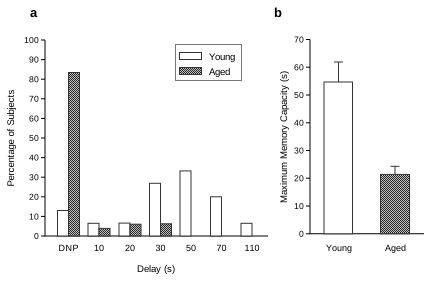
a: Percentage of dogs that were able to complete each delay for both age groups. Note that the majority of aged dogs did not pass (DNP) the 10-s delay. b: Average (± SEM) maximal memory capacity for the dogs that learned the task. Redrawn from the published figure.
Sleep disruption is a hallmark of cognitive aging in both dogs and humans. Our platform utilizes continuous accelerometer monitoring to quantify activity rhythms, nighttime restlessness, and alterations in sleep–wake cycles. These digital biomarkers complement cognitive assessments by providing sensitive measures of behavioral and circadian changes associated with healthy aging, Canine Cognitive Dysfunction Syndrome, and therapeutic intervention response.

Mean (±SEM) total day and night activity counts by age group. Letters a/b mark differences (P < 0.05) between age groups in total day activity counts; x/y mark differences (P < 0.05) in total night activity counts. Zanghi et al., Journal of Veterinary Behavior (2012) 7, 339–347.

Traditional cosinor model over 24 hours for each age group; the cosine curve is calculated from the model. Zanghi et al., Journal of Veterinary Behavior (2012) 7, 339–347.
CSF biomarker panel supports biological interpretation of cognitive decline in aged dogs. Changes in the Aβ42/Aβ40 ratio and neurofilament light chain (NFL) provide complementary measures of Alzheimer’s-like amyloid biology and neuronal injury, helping link cognitive performance with underlying neurodegenerative processes.

Imaging biomarkers support longitudinal assessment of brain structure and function in aged dogs. MRI, FDG-PET, and MRS can be used to evaluate CNS volume, brain metabolism, and functional neurochemical changes, providing complementary evidence of neurodegenerative progression alongside cognitive performance and CSF biomarker outcomes.


Models
Applicable Portfolio Services



Advance your cognitive research with translational confidence.
Whether you are developing therapies for neurodegenerative disease, psychiatric indications, or age-related cognitive decline, our scientists can help you select the right cognitive assays, species, endpoints, and study design for your program. Talk to a researcher to learn how Transpharmation’s cognitive assessment platform can help generate robust, reproducible, and decision-ready data.